Showing posts with label Film. Show all posts

Tuesday, 28 November 2017

Review: Murder on the Orient Express (film)

Name: Murder on the Orient Express
Based on: The novel by Agatha Christie
Starring: Kenneth Branagh, Michelle Pfeiffer, Johnny Depp, Judi Dench
Released: 2017

Murder on the Orient Express is the perfect cinematic spectacle to catch as we dive headlong into winter. Weather-wise, its full of snow. I was one of the few people (it seems) who didn't know the ending before watching the film, which I think made it more enjoyable.


This poster was created specially for
the film by New York illustrator
Johnny Dombrowski. See Inside
The Rock Poster Frame blog

to get your hands on one. 
Hercule Poirot (Branagh) is looking forward to a long overdue holiday when he is compelled to take on a murder case in London. Thankfully, he meets his old friend Bouc in Istanbul, who makes room for the famous Poirot on his train  the luxurious Orient Express where guests travel across Europe in style.

So twelve strangers gather aboard the train for the three-day journey. All they have in common is their ability to afford the expensive ticket. The motley crew – including a shady art dealer, a violent dancer, a rude princess and an American woman in search of husband number three – are thrown into disarray when one of them is killed in the sanctity of their train cabin. They're all suspects and the murderer could, of course, strike again.

Murder on the Orient Express is a classic story that has been continuously retold. And for good reason. It includes money and a love affair, as my Welsh friend put it, but more than that, it takes a long, hard look at the wide moral gap between right and wrong, and the ways in which the human soul can fracture.

In my opinion, as well as being a snowy spectacle, Murder on
the Orient Express
is good old-fashioned entertainment, with great performances from some of Hollywood's finest. The film took a little while to get going, but then it moved at quite a pace  unlike the train they were stranded on. (Sorry.) I enjoyed figuring out whodunit, and now would like to forget the whole thing entirely so that I can pick up the book in a few years' time and experience it afresh as Agatha would have wanted.

Sunday, 20 May 2012

The Artist

Name: The Artist
Director: Michel Hazanavicius
Starring: Jean Dujardin, Bérénice Bejo and John Goodman
Length: 100 min

Year: 2011


The Artist is a silent film about the demise of the silent film, so there’s oodles of room for dramatic irony – in fact, the film opens with the words ‘I won’t talk’. Delicious, if you have a taste for symbolism and symmetry. But don’t be fooled, the word ‘silent’ doesn’t mean there's no soundtrack; the film actually won the 2012 Oscar for Best Music, so there is plenty to listen to.
You may think: ‘A silent film? How can that possibly be engaging when we live in such a noisy world?’ But cast your mind back to a scene on TV last night where someone discovered something shocking – remember the tension as the implications of the shock slowly registered on their face. Longing looks silently thrown across a room can reveal as much about a situation as the patchy dialogue going on over the top. Drama can be at its most dramatic when nothing is said at all.

And The Artist is dramatic. It’s a terribly tragic tale of the demise of a man living in a world that can no longer accommodate the art form he has dedicated his life to. Jean Dujardin plays the silent movie star George Valentin who refuses to move forwards with technology, despite the fact that up-and-coming beauty Peppy Miller (Bérénice Bejo) makes working on ‘talkies’ look rather inviting. Out of stubbornness and pride, George appears to lose everything but his pooch; from his famous tuxedo to his chances of romance with chirpy Peppy.
Incidentally, there should be an award for brilliant animal actors like little Uggie, who debuted in Water for Elephants. Uggie gave a stunning performance and complemented those he acted alongside. Jean Dujardin and Bérénice Bejo kept you hanging the whole way through, and both deserved their respective Oscars (Actor in a Leading Role and Actress in a Supporting Role). George's wonderfully loyal butler, Clifton, was played by James Cromwell – that’s Farmer Hogget to members of the Babe generation.
It was refreshing to see a film so charmingly different. The length was spot-on and the costumes were a feast for the eyes; dapper suits, dazzling flapper dresses, tap shoes and cloche hats. And after a few minutes of watching, I genuinely forgot that nobody was talking.

Monday, 30 January 2012

The Iron Lady

Name: The Iron Lady
Director: Phyllida Lloyd
Starring: Meryl Streep, Jim Broadbent, Richard E. Grant
Length: 105 min
Year: 2011

The Iron Lady is the somewhat controversial offering about the life and times of Lady Margaret Thatcher, first and only female Prime Minister of England (for those of you who don’t know). I came to this film as a political novice, knowing little about her life, and without being alive at the time of her ‘reign’, and I think this had quite an effect on my opinion.


Putting the 'Great' back in 'Great Britain'
The structure is one of retrospection, as ‘Maggie’ (Meryl Streep) looks back on her life and career, sometimes with fondness, and at other times without intention. A photograph, tune or news report will plague her with the recollection of a tough day in the office, and all she has left to comfort her is the hallucination of her late husband, Dennis (Jim Broadbent).

It is these hallucinations about Dennis that have caused a bit of a stir as they are speculative – the real Dennis apparently never spoke out about his wife, so the depiction of their relationship is mostly fictional. Furthermore, the portrayal of Margaret’s dementia-driven hallucinations hardly seems sympathetic given the fact that she is still alive.

Despite this, I personally felt I learnt a lot about the political decisions Thatcher had to make, why she made them, and what the outcomes were. Live footage of events was cleverly interspersed with Meryl’s top-notch acting (the Oscar is in the post, I’m sure).

Short scenes subtly open your eyes to aspects of Thatcher’s personality, for example when being thanked by a young female politician for being an inspiring role model, instead of encouraging the chosen career path of her admirer, Margaret states that one feels like one must ‘do something’. She didn’t take on the most difficult job in the country with the intention of opening doors to young women like herself; she did so purely because she wanted to change the country. And she did just that, which does make her rather inspiring.

Not perhaps the Thatcher film that some have been waiting for, as it is more of a character picture than a political chronology, but after all it is a film, not a documentary. I’m sure several more mature viewers will be disappointed with the lack of politics and the omnipresence of dementia, but as a film, it was very well done – something reflected by the applauding audience!

Friday, 1 July 2011

No regrets? Really?

Name: La Vie En Rose
Director: Olivier Dahan
Starring: Marion Cotillard, Sylvie Testud, Pascal Greggory
Length: 134 mins

Year: 2007

La Vie En Rose is the most recent dramatisation of French singer Edith Piaf’s colourful life. Her early years were spent in the Parisian slums with her alcoholic mother, who struggled to live the artistic life she wanted with a child in tow, so Edith was placed in the care of her grandmother. This was until her father whisked her away to his mother’s brothel for safe-keeping while he went to war.  He then returned and removed his daughter from this relatively stable, if somewhat dangerous, setting and they took to the road with the travelling circus. Not your average start in life.

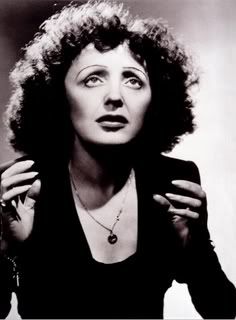
Young Edith's first performance was on the street; her acrobatic father instructed her on the spot to ‘do something’ to entertain the crowd of people gathered around them. Years later, at the age of 20, her vocal talent was discovered and she was given a job as a club singer.  Edith quickly learnt to survive amongst the bawdy music scene, joining in with the culture of excess that surrounded her. Noticing she could do better, Raymond Asso took her under his wing for professional vocal training, and the result was a woman who sang with her hands as well as her voice.

The film scooped up around 30 awards and a similar number of nominations; predominantly for Cotillard’s stunning performance as the turbulent Edith, but also for costume design, make-up and directing, all of which are definitely deserved.

However, La Vie En Rose appears to focus more on Edith’s sufferings than her career and talent. It is obviously attempting to ‘wow’ audiences into admiring her ability to reach such dizzying heights of stardom despite her various obstacles, addictions and losses.
The real Edith

This is all well and good, but her perceived tenacity is often just rudeness.  The word 'diva' must have been invented for Edith, as she treated those around her with little respect, lived a lavish life that led to her own demise, and to top it off, she regretted none of this behaviour. Is that really admirable?

Some have criticised La Vie En Rose for its fragmentary structure: the various events of Edith’s life are presented as flashbacks in what could be seen as an arbitrary order, which has become something of a cliché in the biographical genre. But this structure - clichéd or not - relevantly portrays Edith’s manic mentality. Placing different aged Edith's side-by-side demonstrates her instability - neither the film nor the woman can keep still. 

This is the story of a gutsy, talented and turbulent woman who refused to give up. Not a jolly film by any stretch, but an inspiring and powerful one that ends on a rather stirring note.