Saturday, 31 March 2018

Book awards 2017

A long-overdue round-up of some of my 2017 reads
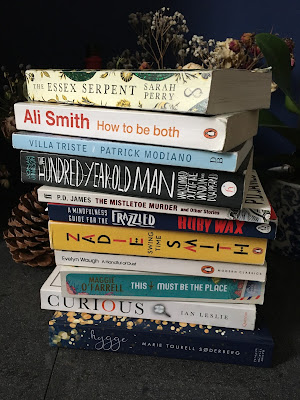
Pile of books read in 2017. Copyright Sophie Blackman

Most atmospheric setting

Has to be the south of France, the setting of Villa Triste… with its enigmatic people, splendid hotels, endless champagne… my awful description does not do it the slightest bit of justice.

Character I’d befriend

Ursula Todd in Life After Life. There are times when she could do with a pal. 

Best for life lessons

A Mindfulness Guide for the Frazzled – not only does Ruby Wax navigate the thorny topic of mental health with wit and wisdom, she teaches you about the scientific make-up of the brain. This is a great way to understand the invisible nuts and bolts that make up our grey matter.

Place I’d most like to visit

The village in Africa that a large portion of Swing Time takes place in.


Biggest surprise

The Hundred-Year-Old Man Who Climbed Out of the Window and Disappeared was one surprise after the next. Each individual scene could have been far-fetched (and I distinctly remember my English teacher telling us not to include something as silly as having a pet elephant in our stories) yet they all worked. It was so satisfying to see all of the threads come together at the end.
 

Most vicious villain

The murderer in P.D James’ A Very Commonplace Murder in The Mistletoe Murder and Other Stories. Nasty. See 'The unfinished one' for what I imagine to be a fuller character picture of
such a man!

The unfinished one

The Psychopath Test. This was an absolutely fascinating read, but seeing the inside of mental asylums from days gone by all got a bit too intense for me! If you’re interested in psychology, and what goes into the making of a killer (see above!), this is one for you.
 
Copyright Sophie Blackman
A Mindfulness Guide for the Frazzled by Ruby
Wax. Impossible to be frazzled in this calming café!
Swing Time by Zadie Smith, image copyright Sophie Blackman
Zadie Smith's Swing Time hops between the UK,
New York and a village in West Africa.

Best nonfiction one

Curious: The Desire to Know and Why Your Future Depends On It – this is full of great anecdotes and case studies that illustrate why it’s important to never stop asking questions. I think parents and teachers would find this fascinating, as it looks at curiosity in children and how education can help or hinder it.

Quick read

The Essex Serpent – I read this on holiday and powered through it in a few days. I really enjoyed the book, but the nerd in me hoped for a bit more science!

Time period I'd like to visit

Between the wars in A Handful of Dust. People had to create a whole new set of social rules after the war. It must have been a baffling time to be alive.

The one to re-read

This award goes to How to be Both. I have more Ali Smith on my list for next year, as I think she’s brilliant, but I do have to concentrate to make sure I don’t miss things! So I would like to revisit this when I am older and wiser.

If you only read one of these

This Must Be the Place – an accessible book that spans generations, visits several countries, has a pacey plot and is written beautifully. One of my new faves!

Sunday, 31 December 2017

Review: The Mistletoe Murder and Other Stories

Title: The Mistletoe Murder and Other Stories
Author: P.D. James
This edition published: 2017
First published: 1969, 1979, 1995, 1996
Publisher: Faber & Faber
Following on from Agatha Christie, this review is of a prolific crime writer from the next generation: P.D James. I picked up The Mistletoe Murder and Other Stories at Paddington Station on a rare occasion when I wasn’t doing a 100-metre dash for a train. I had heard nothing but praise for the ‘Queen of Crime’ and fancied a few short stories to ease myself into the festive spirit.

The Mistletoe Murder and Other Stories by P.D. James. Image copyright Sophie Blackman 2017
The Mistletoe Murder and Other Stories
looking festive.
The first story in the book, ‘The Mistletoe Murder’, was astonishing. While it was published near the end of P.D. James’s long career as a crime writer, it actually takes you right back to the beginning. This is the true story of the murder that happened under the author’s nose one Christmas. She told hundreds of other stories before revealing this one to the world. You can’t help but wonder whether, for years, she was just searching for the right words.

It sounds like a cliché, but it turns out that England used to be like this: a young war widow is invited to her grandmother’s country house for Christmas along with two distant cousins. Young P.D. James didn’t know any of these relatives very well, but she hadn’t exactly been overwhelmed with other invitations. You’ll have to read it to find out which of her relatives committed the murderous act...

Another of the stories, ‘The Twelve Clues of Christmas’ (I must admit, I think titling has come a long way since then), follows a similar plotline. It’s interesting to draw parallels with the first story: a well-to-do family gather in an isolated country house at Christmas and one of them gets their comeuppance. Was this one written as practice until the time the author could finally reveal her own story?

These tales were all written and set a while ago now, but they are great reads with a touch of class. Houses and habits and haircuts may have changed, but the human emotions and motivations explored here are universal, so I’m sure people will still be reading these in years to come. They aren’t gruesome or sensationalist stories full of guts and horror, they instead get under the skin of what causes apparently ordinary people to decide that another person’s life is their's for the taking. The characters here are the everyday people who blend into the background, carrying heavy secrets with them until the end of their own lives. It’s fascinating stuff.

The Mistletoe Murder and Other Stories would be a great stocking-filler, and the perfect read during the mid-afternoon slump on Christmas Day when everyone is either nodding off or walking the dogs… as long as you aren’t in an isolated country house surrounded by bitter relatives with access to the turkey knife, that is…

Tuesday, 28 November 2017

Review: Murder on the Orient Express (film)

Name: Murder on the Orient Express
Based on: The novel by Agatha Christie
Starring: Kenneth Branagh, Michelle Pfeiffer, Johnny Depp, Judi Dench
Released: 2017

Murder on the Orient Express is the perfect cinematic spectacle to catch as we dive headlong into winter. Weather-wise, its full of snow. I was one of the few people (it seems) who didn't know the ending before watching the film, which I think made it more enjoyable.


This poster was created specially for
the film by New York illustrator
Johnny Dombrowski. See Inside
The Rock Poster Frame blog

to get your hands on one. 
Hercule Poirot (Branagh) is looking forward to a long overdue holiday when he is compelled to take on a murder case in London. Thankfully, he meets his old friend Bouc in Istanbul, who makes room for the famous Poirot on his train  the luxurious Orient Express where guests travel across Europe in style.

So twelve strangers gather aboard the train for the three-day journey. All they have in common is their ability to afford the expensive ticket. The motley crew – including a shady art dealer, a violent dancer, a rude princess and an American woman in search of husband number three – are thrown into disarray when one of them is killed in the sanctity of their train cabin. They're all suspects and the murderer could, of course, strike again.

Murder on the Orient Express is a classic story that has been continuously retold. And for good reason. It includes money and a love affair, as my Welsh friend put it, but more than that, it takes a long, hard look at the wide moral gap between right and wrong, and the ways in which the human soul can fracture.

In my opinion, as well as being a snowy spectacle, Murder on
the Orient Express
is good old-fashioned entertainment, with great performances from some of Hollywood's finest. The film took a little while to get going, but then it moved at quite a pace  unlike the train they were stranded on. (Sorry.) I enjoyed figuring out whodunit, and now would like to forget the whole thing entirely so that I can pick up the book in a few years' time and experience it afresh as Agatha would have wanted.

Tuesday, 21 November 2017

Review: A Handful of Dust

Title: A Handful of Dust
Author: Evelyn Waugh
First published: 1934
Publisher (this edition): Penguin Modern Classics

A Handful of Dust was recommended to me during a holiday chat about favourite books, and I've been looking forward to reading this one for a while.

Brenda is married to Tony Last, who enjoys nothing more than a weekend on his inherited countryside estate with his wife and son. After a few years of the quiet life, Brenda misses the thrills of London society, so takes up a small studio flat  along with a superficial lover of insubstantial character  and very quietly moves to the city.


A handful of dust by Evelyn Waugh, photo copyright Sophie Blackman
A Handful of Dust by Evelyn Waugh
What follows is the tale of a bitter divorce, but it isn't written with bitterness. The lightness of touch pokes fun at a group of people who have more money and time than they know what to do with. To prevent boredom, they go to endless parties at each others houses, organise each others love lives and keep what they mistakenly think of as secrets. This is not a story about politics or war, but the changing economic situation of the 1930s looms behind them all like a shadow, and it becomes clear that there might not be room in the modern world for this lot and their ways.

On first impression, A Handful of Dust was more accessible than expected, written by a man with the ability to see the humour in uncomfortable and tragic places. There are also some beautiful phrases here, and one of my favourites is: "...llamas packed with works of intricate craftsmanship...". Without giving away too much, parts of this book will satisfy your inner Amazonian explorer. A nice surprise, given that the majority of the story is set in a gothic mansion.

I mentioned this in a to-read list a few weeks ago, but a distant relative of mine was Evelyn Waugh's housekeeper when he was a boy, which added a layer of fun detective work to the story for me. John Last, son of the divorcing couple, has a nanny, and I love the thought that this sincere character could be based on a voice that trickled down the generations to my own ears. Perhaps a tenuous link, but I'm going to stick with it, as they don't come along often!

A Handful of Dust was an entertaining read with an undercurrent of injustice that touched all of the main characters. I don't envy them, despite their spacious houses and bustling social lives. Add this to your list of must-read classics.

Monday, 13 November 2017

Review: Love in a Cold Climate (TV)

Name: Love in a Cold Climate
Starring: Rosamund Pike, Elisabeth Dermot Walsh, Megan Dodds, Javier Alcina
Length: 2 hours 30 mins, over two episodes
Year: 2002

I’ve cheated! Love in a Cold Climate is still on my to-read list, but it is also on Netflix. After a busy weekend earlier this month, I conked out on the sofa, tuned into this mini-series and made a Christmas pom-pom.

The BBC adaptation of Love in a Cold Climate
Three upper-class girls in the 1930s are looking for love, and maybe even marriage. After a fairly dowdy coming-out ball, things start to get interesting for them. Our narrator, Fanny (Rosamund Pike), is constantly being compared to her mother, the infamous ‘Bolter’, a woman of – shall we say – a loose moral persuasion, according to the rigid standards of the time. I read about a real-life Bolter a few years ago in a book by Francis Osborne, and Idina Sackville was apparently the inspiration for Fanny's mother.

Polly, Fanny’s beautiful friend, has to endure ball after ball while her snobbish mother, Lady Montdore, waxes lyrical over her daughter’s apparent ambivalence to romance. It is Polly who questions, on returning from Imperial India, how love will differ in a cold climate. The secrets of her heart are revealed when she marries her uncle, her mother’s lover, the promiscuous ‘Boy’, scandalising society and officially cutting ties with the outraged Lady Montdore.

Fanny’s cousin, Linda (Elizabeth Dermot Walsh), defies her father by marrying a German man, and in doing so appears to fall on her feet, having both of the boxes ‘marriage’ and ‘love’ ticked. That is, until it goes pear-shaped when Linda’s head and heart are turned by a communist speaker in Hyde Park. Her story was my favourite, as her pursuit of true love takes her around the world and back again, ending in England during the Blitz.

This TV adaptation combines both Love in a Cold Climate and Pursuit of Love, so I’m not one hundred percent sure where one story began and the other ended. All the more reason to read the books! The show was pacy and depicted the girls' spirit as they navigated life, love and society in the changing world between the wars. The characters around them were eccentric and not always that likeable, which made Fanny, Polly and Linda all the more endearing.

One for a rainy Sunday afternoon!

Monday, 6 November 2017

Review: Villa Triste

NameVilla Triste
Author: Patrick Modiano
First Published: September 1975
This Edition Published: May 2016
Publisher: Daunt Books

This dusky-looking item was a true impulse buy. I was aimlessly browsing a bookshop one lunchtime about a year ago looking for something a bit different. I was enticed by Villa Triste, with its shiny, golden title hovering over a musty, broken and abandoned house with a beautiful lakeside view.

The faded glamour of Patrick Modiano's Villa Triste
The narrator of Villa Triste is a mysterious young
man who seems, at times, wise beyond his years.
Victor Chmara (if that is his real name) has fled from who-knows-where to the safe haven of a French town on the edge of a Swiss lake. He lives in fear, for reasons that are never entirely revealed, yet feels safe in the knowledge that he could cross the lake to Switzerland
if trouble ever catches up with him.


Sitting in a hotel one evening, Victor meets two charming people: the up-and-coming actress, Yvonne Jacquet, and her eccentric friend, René Meinthe. And so begins a friendship that takes him to debauched parties and expensive hotels.

But his new friends keep him at arm’s length, and
their existence provokes more questions than they themselves answer. Where does their money come from? Where have they come from? Where does Ren
é disappear at night? And why does the phone keep ringing in the empty Villa Triste? The town they live in, at first so glamorous, begins to feel shallow, corrupt and dirty as the source of the mystery becomes apparent.

The book opens years later, as Victor views the dilapidated town from a bus window. Villa Triste pays close attention to deeply-held feelings and atmospheres that simmer just below the surface. It captures the haze of memory, the holes where things have been forgotten and the rosy tints we apply to the past. It also paints a character who doesn't quite understand the power plays and complicated relationships happening around him. All of these elements come together to create a perfectly haunting, mysterious and atmospheric read.

Patrick Modiano won the Nobel prize for literature in 2014 and you can buy Villa Triste from Daunt Books

Monday, 30 October 2017

Review: This Must Be the Place

Name: This Must be the Place
Author: Maggie O'Farrell
First Published: May 2016
Publisher: Tinder Press

My latest read took me on a journey to deepest Ireland via sunny San Francisco, a forest in Scotland, a yacht sashaying across the Swedish seas and a messy London flat. And that list isn't even exhaustive. The snippet of map on the front cover of This Must Be the Place doesn't lie  these characters like to travel.

I was drawn to Maggie O'Farrell after reading an old Guardian article she wrote about the process of writing. While her baby slept, swaddled in a sling, she would take to the keyboard and type until the young babe awoke. Impressive.

This Must Be the Place by Maggie O'Farrell, sitting proudly in my armchair
This Must Be the Place pivots around two people. We follow the twists and turns of their lives, both before they meet and afterwards. Daniel is an American linguistics professor. He is kind, loud and flawed. Claudette is a half-French, somewhat reluctant movie star with a stuttering son and a shotgun. When we meet them they are living, together with a handful of children, in a secluded house in rural Ireland at the end of a long track punctuated with security gates.

Things change one day when Daniel hears the voice of someone he used to know through his car radio. He can't help himself  he has to find out what happened to Nicola Janks. He only knew her for a short time twenty years ago, so his newfound mission couldn't possibly upset the present-day apple cart, could it?

I loved following the trails of events in This Must Be the Place, jumping through time zones, globetrotting and witnessing situations through multiple viewpoints  the children, the friends, the lovers. This book is a great example of cause and effect: the life of a character can be altered by an event that happened years ago, in another country, before they were even born. A spooky thought!

Maggie's writing was atmospheric and accessible, and she captures fleeting moments and lingers on them in a way that you don't have time to do in real life. It felt indulgent. I classify this book as one to snuggle up with on the sofa!

This edition is currently on sale in Waterstones if you'd like to add it to your shelf.

Monday, 16 October 2017

Books to Read

The ten books I'd like to read next (and potentially review!)

1. A Handful of Dust by Evelyn Waugh

An old and distant relative of mine was Evelyn Waugh's housemaid when he was a boy in Somerset. That's as good a reason as any to start reading his books!

2. Good Night Stories for Rebel Girls by Elena Favelli

This is technically a children's book, but it just sounds so fab.

3. The Color Purple by Alice Walker

This literary stalwart set in the USA's deep south in the 1930s has been on my radar for years. I've been building up to it and think I'm ready...

4. The Watchmaker of Filigree Street by Natasha Pulley

I am unashamedly judging this book by its cover. Just look at that shine!

5. Les Parisiennes by Anne Sebba

So many wonderful and inspirational women lived in Paris during Nazi occupation - fashion designers, spies, novelists, racing drivers - and this book tells their true stories.

6. Love in a Cold Climate by Nancy Mitford

This one has been on the Christmas list for years. Will 2017 be the year, Father C?

7. The Madonna of the Mountains by Elise Valmorbida

I rubbed shoulders with Elise in her wonderful creative writing class a couple of years ago. Am so excited to read her epic sweep of a novel when it comes out in 2018.

8. The Casual Vacancy by J.K. Rowling

As a big Potter fan I have utter faith in J.K.'s talents.

9. A God in Ruins by Kate Atkinson

This sequel to one of my favourite books, Life After Life, promises to reveal what happened to the world's loveliest character, Teddy. I'm borrowing this one from Mum so will have to read it quick.

10. Changing my Mind by Zadie Smith

I like changing my mind too, so I think I'll get on well with Zadie's essays on her influences and inspirations.

Wednesday, 19 September 2012

Review: The Paris Wife


Name: The Paris Wife
Author: Paula McLain
First published: 2010
Published by: Virago


The Paris Wife came into my life shortly after I visited the French capital in May. I wanted to read something vaguely Parisian and the title suggested this might fit the bill.

This is the story of mild Hadley Richardson and her first marriage to one of America’s literary greats: the not-so-mild Ernest Hemingway, of whom I knew nothing before I read this book. The two met at a party in Chicago one summer when Hadley was 28 and Ernest was an ambitious yet unknown 21-year-old. After a whirlwind romance and a speedy marriage, despite the misgivings of Hadley’s best friend, they set sail for a new life in Paris.
Success is by no means instant for Ernest, but it becomes very clear very quickly that work is his priority; a passion he shares with friends Ezra Pound, Gertrude Stein, F. Scott Fitzgerald and Ford Maddox Ford. But will the charms of post-war Paris entice loved-up newlyweds Ernest and Hadley? Will they adopt the ‘bohemian’ (read: promiscuous) ways of their peers? It seems unlikely, but not impossible.

This great love affair is set up to fail from the beginning, although this becomes difficult to believe when the couple are at their peak. As Hadley and Ernest slowly unravelled I did wonder how their shake-up could possibly come as a surprise, but then came the blow – and I was outraged!


Ernest Hemingway and Hadley Richardson
Steeped with glamorous settings, literary figures and loose morals, The Paris Wife recreates the atmosphere of 1920s Paris, where writers spent their days in cafés, while those that loved them waited, followed, and hoped they wouldn’t be left behind. Hadley was not an artist and her position on the outskirts of this social set meant she noticed the turmoil that fuelled the talent.
After American beginnings, The Paris Wife did indeed fulfil my need for a Parisian tale, and also told me a thing or two about the ways of the disillusioned modernists. Reading about Hemingway’s early years has made me want to read his work – but there was a time during The Paris Wife when I never wanted to read a word of Hemingway – or hear his name – ever again!

Thursday, 7 June 2012

One man and his cat


Name: A Street Cat Named Bob
Author: James Bowen
First published: 2012
Published by: Hodder and Stoughton

I first came across James Bowen and his remarkable street cat the same way many others did – I saw them. Admittedly I didn’t see them busking in Covent Garden, I saw a picture in the back of Bookseller magazine, but there is definitely something about Bob that makes you look twice.

This is the true story of a man who lived hand-to-mouth in London and the injured cat he nursed back to health. James and Bob made a name for themselves on the streets, first busking and then selling Big Issue, and before they knew it (literally), they had an online following.

A Street Cat Named Bob is definitely one for cat lovers. Not only will you be able to recognise Bob’s feline idiosyncrasies, you will also pick up some handy cat-care tips along the way. Did you know that cats can develop an addiction to catnip? Nor did I.

Bob promoting his new book.
I also learnt a thing or two about heroin addiction, as author James tells the story of how he turned his life around and kicked his drug habit – and he has no qualms attributing this largely to his new friend Bob.

The well-intentioned characters make this a very loveable book, and their story is all the more engaging for being true. It hasn’t been a bed of roses for James and Bob, but the way they deal with their problems – by simply caring for each other – warms the heart.

A Street Cat Named Bob will leave you with a fuzzy feeling inside and you’ll probably reach over to give your own moggy a cuddle – and then knit him a scarf.

You can see more of Bob on youtube, and his tale will be published in paperback on 13 September.

Sunday, 20 May 2012

The Artist

Name: The Artist
Director: Michel Hazanavicius
Starring: Jean Dujardin, Bérénice Bejo and John Goodman
Length: 100 min

Year: 2011


The Artist is a silent film about the demise of the silent film, so there’s oodles of room for dramatic irony – in fact, the film opens with the words ‘I won’t talk’. Delicious, if you have a taste for symbolism and symmetry. But don’t be fooled, the word ‘silent’ doesn’t mean there's no soundtrack; the film actually won the 2012 Oscar for Best Music, so there is plenty to listen to.
You may think: ‘A silent film? How can that possibly be engaging when we live in such a noisy world?’ But cast your mind back to a scene on TV last night where someone discovered something shocking – remember the tension as the implications of the shock slowly registered on their face. Longing looks silently thrown across a room can reveal as much about a situation as the patchy dialogue going on over the top. Drama can be at its most dramatic when nothing is said at all.

And The Artist is dramatic. It’s a terribly tragic tale of the demise of a man living in a world that can no longer accommodate the art form he has dedicated his life to. Jean Dujardin plays the silent movie star George Valentin who refuses to move forwards with technology, despite the fact that up-and-coming beauty Peppy Miller (Bérénice Bejo) makes working on ‘talkies’ look rather inviting. Out of stubbornness and pride, George appears to lose everything but his pooch; from his famous tuxedo to his chances of romance with chirpy Peppy.
Incidentally, there should be an award for brilliant animal actors like little Uggie, who debuted in Water for Elephants. Uggie gave a stunning performance and complemented those he acted alongside. Jean Dujardin and Bérénice Bejo kept you hanging the whole way through, and both deserved their respective Oscars (Actor in a Leading Role and Actress in a Supporting Role). George's wonderfully loyal butler, Clifton, was played by James Cromwell – that’s Farmer Hogget to members of the Babe generation.
It was refreshing to see a film so charmingly different. The length was spot-on and the costumes were a feast for the eyes; dapper suits, dazzling flapper dresses, tap shoes and cloche hats. And after a few minutes of watching, I genuinely forgot that nobody was talking.

Monday, 30 January 2012

The Iron Lady

Name: The Iron Lady
Director: Phyllida Lloyd
Starring: Meryl Streep, Jim Broadbent, Richard E. Grant
Length: 105 min
Year: 2011

The Iron Lady is the somewhat controversial offering about the life and times of Lady Margaret Thatcher, first and only female Prime Minister of England (for those of you who don’t know). I came to this film as a political novice, knowing little about her life, and without being alive at the time of her ‘reign’, and I think this had quite an effect on my opinion.


Putting the 'Great' back in 'Great Britain'
The structure is one of retrospection, as ‘Maggie’ (Meryl Streep) looks back on her life and career, sometimes with fondness, and at other times without intention. A photograph, tune or news report will plague her with the recollection of a tough day in the office, and all she has left to comfort her is the hallucination of her late husband, Dennis (Jim Broadbent).

It is these hallucinations about Dennis that have caused a bit of a stir as they are speculative – the real Dennis apparently never spoke out about his wife, so the depiction of their relationship is mostly fictional. Furthermore, the portrayal of Margaret’s dementia-driven hallucinations hardly seems sympathetic given the fact that she is still alive.

Despite this, I personally felt I learnt a lot about the political decisions Thatcher had to make, why she made them, and what the outcomes were. Live footage of events was cleverly interspersed with Meryl’s top-notch acting (the Oscar is in the post, I’m sure).

Short scenes subtly open your eyes to aspects of Thatcher’s personality, for example when being thanked by a young female politician for being an inspiring role model, instead of encouraging the chosen career path of her admirer, Margaret states that one feels like one must ‘do something’. She didn’t take on the most difficult job in the country with the intention of opening doors to young women like herself; she did so purely because she wanted to change the country. And she did just that, which does make her rather inspiring.

Not perhaps the Thatcher film that some have been waiting for, as it is more of a character picture than a political chronology, but after all it is a film, not a documentary. I’m sure several more mature viewers will be disappointed with the lack of politics and the omnipresence of dementia, but as a film, it was very well done – something reflected by the applauding audience!

Monday, 19 December 2011

Her Fearful Symmetry

Name: Her Fearful Symmetry
Author: Audrey Niffenegger
First published: 2009
Published by: Jonathan Cape (UK)


Her Fearful Symmetry is the much anticipated successor of The Time Travelers Wife. This is the tale of two sisters, their parents, their deceased aunt Elspeth, and the enigmatic neighbours they encounter after inheriting their aunt’s London flat.

Julia and Valentina Poole are identical to the eye, but ‘mirror twins’ in almost every other way; from their internal organs (Valentina’s heart is on the opposite side to Julia’s) to their personalities. Their Henry James-esque relocation to England presents some challenges as Valentina increasingly demands her individuality. This sounds reasonable enough, but leads her to make some life-altering – in every sense of the word – decisions.

Her Fearful Symmetry is a ghost story that doesn’t begin as one. Elspeth’s funeral opens the book, which suggests that she will be known only through the legacy she leaves behind. But this is not the case as unfinished business prevents her from leaving her flat. Her partner Robert also has problems leaving her flat and struggles to keep his distance when the twins move in.

Similarly, upstairs neighbour Martin is confined to the walls of his apartment but this is due to OCD rather than unfinished business. A theme soon emerges: a group of people are thrown together in a slightly claustrophobic manner (despite the large floor-plans of their homes) and they cannot regain a sense of normality until they leave.

Niffenegger creates very convincing characters that are easy to care about. But just as you think you’ve mastered them, she throws in a huge plot twist which forces you to question their motives and morals.  

Here, death is just something people live with, not something to get upset about. This gives the novel a gothic edge, so perhaps not a book for a sunny day at the beach.

After finishing this book I was left flicking through the acknowledgements to see if they would shed any light on what just happened. They didn’t, and I was left with a bit of unfinished business myself.

For more information, or to order the book, visit: audreyniffenegger.com/her-fearful-symmetry

Friday, 8 July 2011

Tales of luxury lost

Name: Babylon Revisited
Author: F. Scott Fitzgerald
First published: ‘Babylon Revisited’, 1935; ‘The Cut-Glass Bowl’, 1920; ‘The Lost Decade’, 1989
Published by: Penguin


This slim volume includes just three short stories written by Fitzgerald over a large time span, all of which contain themes of past decadence and reformed characters struggling to gain the trust of others. Fitzgerald is famous for his Tales of the Jazz Age, but these are tales of the post-jazz age; an era which hadn't yet dawned upon society at the time 'The Cut-Glass Bowl' was written. Fitzgerald is often praised for his eerie powers of foresight, and this tale is one such example.
Charlie Wales, protagonist of ‘Babylon Revisited’, is a recovered hedonist who now finds more comfort in the presence of his daughter than in alcohol. He has lived a clean and stable life for many years since his wife’s death, and wishes to reclaim custody of his only child from his sister-in-law, Marion Peters. Unfortunately, past events render Marion incapable of trusting Charlie, even though he does appear to be a sensible and loving chap. But it is easy to see why her suspicions are roused, as other less reformed jazz-age creatures are still on the scene, reminding her of troubled times.
 ‘The Cut-Glass Bowl’ opens with a different tone but the similar theme of luxury lost is instantly recognisable. The metaphorical ‘cut-glass age’ is historically placed alongside the Stone Age and Bronze Age in a satirical take on the decadence of this material. Mrs Evylyn Piper received the bowl from a jilted suitor who likened it to her because she was beautiful, hard and empty. But aside from this unflattering character statement, Evie, like Charlie, has seen the error of her ways and is on the verge of regaining the trust of her husband when an untimely occurrence gets in the way. We are not 100% sympathetic, but are able to feel the injustice of the situation, as these characters appear to be serving a penance for actions they long since committed.

'The Lost Decade' is a mere six pages long, so in summarising it I would probably give away a little too much. Let’s just say it fits in well with the other two stories. In my experience, you tend to know what you’re getting with F. Scott, but he does what he does extremely well and knows how to keep those pages turning.
 

Friday, 1 July 2011

No regrets? Really?

Name: La Vie En Rose
Director: Olivier Dahan
Starring: Marion Cotillard, Sylvie Testud, Pascal Greggory
Length: 134 mins

Year: 2007

La Vie En Rose is the most recent dramatisation of French singer Edith Piaf’s colourful life. Her early years were spent in the Parisian slums with her alcoholic mother, who struggled to live the artistic life she wanted with a child in tow, so Edith was placed in the care of her grandmother. This was until her father whisked her away to his mother’s brothel for safe-keeping while he went to war.  He then returned and removed his daughter from this relatively stable, if somewhat dangerous, setting and they took to the road with the travelling circus. Not your average start in life.

Young Edith's first performance was on the street; her acrobatic father instructed her on the spot to ‘do something’ to entertain the crowd of people gathered around them. Years later, at the age of 20, her vocal talent was discovered and she was given a job as a club singer.  Edith quickly learnt to survive amongst the bawdy music scene, joining in with the culture of excess that surrounded her. Noticing she could do better, Raymond Asso took her under his wing for professional vocal training, and the result was a woman who sang with her hands as well as her voice.

The film scooped up around 30 awards and a similar number of nominations; predominantly for Cotillard’s stunning performance as the turbulent Edith, but also for costume design, make-up and directing, all of which are definitely deserved.

However, La Vie En Rose appears to focus more on Edith’s sufferings than her career and talent. It is obviously attempting to ‘wow’ audiences into admiring her ability to reach such dizzying heights of stardom despite her various obstacles, addictions and losses.
The real Edith

This is all well and good, but her perceived tenacity is often just rudeness.  The word 'diva' must have been invented for Edith, as she treated those around her with little respect, lived a lavish life that led to her own demise, and to top it off, she regretted none of this behaviour. Is that really admirable?

Some have criticised La Vie En Rose for its fragmentary structure: the various events of Edith’s life are presented as flashbacks in what could be seen as an arbitrary order, which has become something of a cliché in the biographical genre. But this structure - clichéd or not - relevantly portrays Edith’s manic mentality. Placing different aged Edith's side-by-side demonstrates her instability - neither the film nor the woman can keep still. 

This is the story of a gutsy, talented and turbulent woman who refused to give up. Not a jolly film by any stretch, but an inspiring and powerful one that ends on a rather stirring note.

Monday, 6 June 2011

One day you'll surely read this book

Name: One Day
Author: David Nicholls
First published: July 2009
Published by: Hodder

 
Considering the high expectations I had for ‘the book of the moment’,* I was slightly disappointed with the opening chapter of One Day. I wasn’t totally sure whether I was supposed to like Dexter or not, and I later experienced the same feelings towards Emma. But the novel swiftly became attached to my person at all times.
 

We are first introduced to Emma Morley and Dexter Mayhew shortly after they are introduced to each other: on the eve of their graduation. The novel ends the following morning, but the story of their lives is chronologically mapped out in between. The date is July 15th, aka St Swithin’s Day, and the narrator revisits them annually on this date for twenty years.

At first sight the structure appears to be an idealistic one, but the tale is injected with a dose of grim reality from the off. Neither are propelled into their dream career and lifestyle; something that will strike a chord with the recent graduate and evoke past memories in the long-since-graduated.

The course of their lives run very differently - sometimes they are together, other times apart - and it becomes increasingly evident that these two people bring out the best in each other. Suspense gathers as you wonder if they’ll ever get together, and frustration ensues when coincidences prevent them from getting their mail or reaching the phone in time. This novel is the ultimate dramatisation of any question beginning with ‘what if...?’

But One Day is more than just a version of the classic tale of nearly-there lovers; Nicholls has turned this most basic of premises into a heart-wrenching contemporary story with its feet firmly in reality. There are several laugh-out-loud moments, as the narrative is as witty as the characters, yet strong emotions are somehow evoked without a hint of sugary language. This mixture of comedy and romance makes it readable for both sexes.

Nicholls perfectly captures the idealism and anxiety of the post-university period. Emma feels ‘as if a fire alarm had gone off in the middle of the night and she was standing on the street with her clothes bundled up in her arms. If she wasn’t learning, what was she doing?’  Dexter is slightly less anxious about his future; ‘He wanted to live life in such a way that if a photograph were taken at random, it would be a cool photograph.’ On paper they are not exactly a match made in heaven, but this adds a further dose of reality. This realism borders on melancholy at times, but to me that was no bad thing. One Day does not view life through rose-tinted spectacles.

Dexter becomes a Russell Brand-type figure at his worst, while Emma is ever the down-to-earth librarian type, although reducing these loveable characters to types does them no justice whatsoever. They are perfectly rounded and their failings make them human. Dexter’s tragic flaw is his tendency towards excess; alcohol, drugs, and women, but Emma is struck by a tragedy of a different kind, without any prior warning or personal blame.

Is this a novel which speaks to a generation? Yes; the excessive consumption of alcohol will no doubt strike a chord with many, as will the question of what on earth comes next when education is all you have known since you were knee high to a grasshopper. I would heartily recommend this book to most people I know, and have already begun doing so. If you only read one book this year, chose this one.


*according to telegraph.co.uk